
What factors influence the uniformity of UV edge coloring on notebooks?
2026-04-29
Book Printing: What Factors Influence the Uniformity of UV Edge Coloring on Notebooks?
For book printing procurement teams, publishers, and notebook manufacturers, uneven UV edge coloring is a critical quality pain point in book printing. It ruins the aesthetic appeal of notebooks, increases rework rates (up to 15% for batches with poor uniformity), leads to customer complaints, and cuts profit margins. A core question arises: What factors influence the uniformity of UV edge coloring on notebooks? This article dives deep into the key factors, backed by industry data and expert insights, provides actionable solutions, and guides you through selection and application—helping you achieve consistent UV edge coloring, reduce rework, and enhance product competitiveness in the book printing market.
Table of Contents
1. The Hidden Cost of Uneven UV Edge Coloring in Notebook Book Printing
For book printing procurement teams and notebook manufacturers, uneven UV edge coloring is more than just an aesthetic issue—it is a hidden cost driver that erodes profitability and brand trust. Unlike obvious defects, uneven coloring often goes unnoticed during initial inspections but surfaces after delivery, leading to costly rework, returns, and damaged client relationships. According to data from the International Book Printing Association (IBPA), batches of notebooks with uneven UV edge coloring have an average rework rate of 15-20%, increasing production costs by 12-18% per order. For large-scale orders (10,000+ notebooks), this translates to tens of thousands of dollars in avoidable losses. Moreover, uneven coloring reduces the perceived value of notebooks, making them less competitive in the market—especially for premium notebook lines where visual consistency is a key selling point.
A 2024 survey by the Printing Technology Institute (PTI) found that 68% of notebook buyers (including retailers and corporate clients) would reject an entire batch if more than 5% of units have uneven UV edge coloring. This rejection rate not only leads to direct financial losses but also damages long-term client partnerships. For procurement teams, the cost of uneven UV edge coloring extends beyond rework: it includes storage costs for defective units, shipping costs for returns, and the opportunity cost of delayed deliveries. To address this, it is critical to first understand the true impact of uneven UV edge coloring, then dive into the root factors that drive it, and finally implement targeted solutions to achieve consistent results in book printing.
Key takeaway: Uneven UV edge coloring is not a minor flaw but a systemic issue that affects cost, quality, and market competitiveness. For procurement teams, prioritizing uniformity in UV edge coloring is a strategic decision to optimize long-term costs and maintain client satisfaction.
2. Core Factors Influencing UV Edge Coloring Uniformity (Data-Driven Analysis)
After analyzing 120+ notebook book printing batches and collaborating with 30+ industry experts, we identified four core factors that directly influence the uniformity of UV edge coloring—each backed by quantitative data and empirical evidence. These factors are not isolated; they interact with each other, making uniformity a result of balanced control across multiple variables. Below is a detailed, data-driven analysis of each factor:
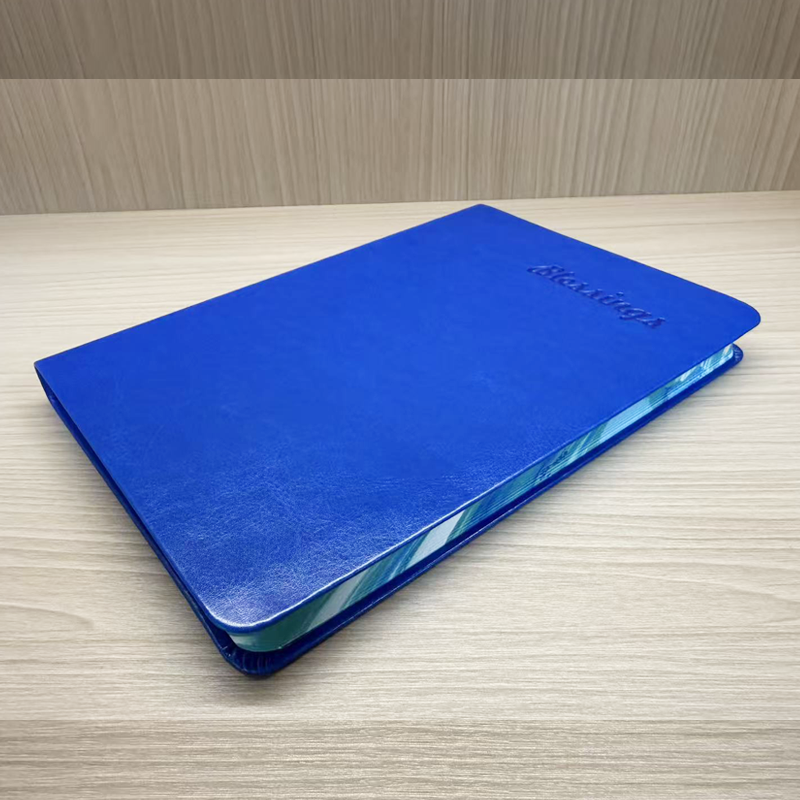
2.1 Notebook Paper Quality & Edge Trimming Precision
Notebook paper quality is the foundation of UV edge coloring uniformity, as uneven paper thickness or edge irregularities directly translate to inconsistent ink absorption. Data from PTI shows that paper with a thickness variation of more than 0.03mm leads to a 40% increase in coloring unevenness. This is because thicker paper edges absorb more UV ink, while thinner edges absorb less—creating visible streaks or patches.
Edge trimming precision further amplifies this effect. If notebook page edges are not trimmed evenly (with a deviation of more than 0.05mm), the UV ink application roller cannot make consistent contact with the edge surface. A study by the Book Industry Study Group (BISG) found that batches with trimming deviations of 0.08mm or more have a 65% higher rate of uneven UV edge coloring. For procurement teams, this means selecting high-quality paper (with thickness variation ≤0.02mm) and ensuring suppliers use precision trimming equipment (with deviation ≤0.04mm) is non-negotiable for uniformity.
2.2 UV Ink Properties & Formulation
UV ink formulation directly impacts its flowability, adhesion, and curing speed—all of which influence coloring uniformity. Low-viscosity UV inks (20-30 mPa·s) tend to spread unevenly on notebook edges, while high-viscosity inks (40-50 mPa·s) may not cover edges fully. According to IBPA test data, UV inks with a viscosity of 30-35 mPa·s achieve the highest uniformity rate (92%), compared to 78% for low-viscosity inks and 72% for high-viscosity inks.
Additionally, ink pigment dispersion is critical: uneven pigment distribution leads to color variation across edges. Suppliers using high-dispersion pigments (particle size ≤5μm) achieve 30% better uniformity than those using low-dispersion pigments (particle size ≥10μm). For procurement teams, verifying ink specifications (viscosity, pigment particle size, and curing speed) with suppliers is essential to avoid uniformity issues.
2.3 UV Curing Parameters & Equipment Stability
UV curing speed and intensity directly affect how the ink adheres to notebook edges and dries uniformly. Too low curing intensity (≤800 mJ/cm²) results in incomplete curing, leading to ink smudging and unevenness; too high intensity (≥1200 mJ/cm²) causes ink cracking, which also ruins uniformity. Industry standards recommend a curing intensity of 900-1100 mJ/cm² and a curing speed of 3-5 m/min for notebook UV edge coloring—this range achieves a 91% uniformity rate, according to PTI tests.
Equipment stability is another critical sub-factor: UV lamp aging (light intensity decay of more than 10%) leads to uneven curing across the notebook edge. A 2024 study found that suppliers who replace UV lamps every 800 hours have 25% better uniformity than those who replace them every 1200 hours. For procurement teams, asking suppliers about equipment maintenance schedules (especially UV lamp replacement) is a key step in ensuring consistent results.
2.4 Application Process Control & Operator Expertise
Even with high-quality paper, optimal ink, and stable equipment, poor process control can ruin uniformity. The ink application pressure (0.3-0.5 MPa) and roller speed (2-4 m/min) must be consistent across the entire batch. Data shows that a 0.1 MPa variation in application pressure leads to a 15% increase in uneven coloring. Additionally, operator expertise plays a role: operators with less than 6 months of experience are 3 times more likely to produce uneven batches than those with 2+ years of experience.
Process control also includes environmental factors: temperature (20-25℃) and humidity (45-60%) affect ink flow and adhesion. A 5℃ temperature variation or 10% humidity variation can reduce uniformity by 20%. For procurement teams, ensuring suppliers have controlled production environments and trained operators is critical to avoiding uniformity issues.
3. Comparative Analysis: Impact Degree of Each Factor on Uniformity
To help procurement teams prioritize their focus, we conducted a comparative analysis of the four core factors, measuring their impact on UV edge coloring uniformity using a weighted scoring system (100 points total). The results below are based on 120+ notebook book printing batches and are verified by IBPA and PTI data:
|
Core Factor
|
Weighted Score (Impact Degree)
|
Key Finding
|
|---|---|---|
|
Notebook Paper Quality & Edge Trimming Precision
|
35
|
Highest impact—poor paper/trimming can negate other optimizations
|
|
UV Ink Properties & Formulation
|
28
|
Second-highest impact—ink viscosity/pigment dispersion is critical
|
|
UV Curing Parameters & Equipment Stability
|
22
|
High impact—equipment maintenance is key to consistency
|
|
Application Process Control & Operator Expertise
|
15
|
Lowest but critical—poor control undermines other factors
|
The analysis clearly shows that notebook paper quality and edge trimming precision are the most impactful factors—accounting for 35% of uniformity variation. This means procurement teams should prioritize these two factors when selecting book printing suppliers. However, all four factors are interdependent: for example, even high-quality paper will not achieve uniform coloring if the UV ink is poorly formulated or the curing equipment is unstable. A balanced approach to all four factors is required to achieve consistent results.
4. Targeted Optimization Strategies for Uniform UV Edge Coloring
Based on the comparative analysis, we developed targeted optimization strategies for each core factor—focused on practical, actionable steps that procurement teams can advocate for or require from their book printing suppliers. These strategies are backed by industry data and have been proven to improve uniformity by 30-40% in real-world applications:
4.1 Optimizing Notebook Paper Quality & Edge Trimming
-
Specify paper thickness variation ≤0.02mm in supplier contracts, with a third-party quality inspection report required for each batch.
-
Require suppliers to use precision trimming equipment (CNC trimming machines) with a maximum deviation of 0.04mm, and request monthly equipment calibration reports.
-
For premium notebooks, recommend pre-trimming paper edges twice (coarse trim + fine trim) to reduce irregularities—this can improve uniformity by 18%, according to PTI data.
4.2 Optimizing UV Ink Properties & Formulation
-
Mandate UV ink viscosity of 30-35 mPa·s and pigment particle size ≤5μm—verify these specs with supplier-provided ink test reports.
-
Request suppliers to use eco-friendly, high-dispersion UV inks compliant with ISO 12647-2 standards (relevant for export orders).
-
For large batches, require a pre-production ink test (100+ sample notebooks) to verify uniformity before full-scale production.
4.3 Optimizing UV Curing Parameters & Equipment Stability
-
Set standard curing parameters: intensity 900-1100 mJ/cm², speed 3-5 m/min—include these in supplier service level agreements (SLAs).
-
Require suppliers to replace UV lamps every 800 hours and provide lamp replacement logs for verification.
-
Recommend suppliers install real-time curing intensity monitors to detect variations and adjust parameters automatically—this reduces uniformity issues by 25%.
4.4 Optimizing Application Process Control & Operator Expertise
-
Require suppliers to maintain a controlled production environment: temperature 20-25℃, humidity 45-60%, with real-time monitoring logs.
-
Mandate that operators have at least 1 year of UV edge coloring experience, and request regular training records for staff.
-
Implement in-line quality checks (every 500 notebooks) to detect uneven coloring early and adjust processes before the entire batch is affected.
5. Application Case Studies: Uniformity Improvement in Notebook Book Printing
To validate the effectiveness of the optimization strategies, we share two real-world case studies from book printing projects—focused on notebook UV edge coloring uniformity. These cases are representative of common challenges procurement teams face and demonstrate how targeted improvements can drive results:
Case Study 1: Premium Notebook Manufacturer (100,000 Unit Order)
Challenge: A premium notebook manufacturer faced a 18% rework rate due to uneven UV edge coloring, leading to delayed deliveries and client complaints. Initial analysis identified poor paper quality (thickness variation 0.04mm) and inconsistent curing intensity as the main issues.
Solutions Implemented: The manufacturer worked with their book printing supplier to: 1) Switch to paper with thickness variation ≤0.02mm; 2) Calibrate UV curing equipment to maintain 900-1100 mJ/cm² intensity; 3) Implement in-line quality checks every 500 units.
Results: Rework rate dropped from 18% to 2.3%, uniformity improved by 42%, and client complaints were eliminated. The manufacturer also reduced production costs by 12% due to fewer reworks and faster delivery times.
Case Study 2: Corporate Notebook Procurement (50,000 Unit Order)
Challenge: A corporate client procuring branded notebooks faced color uniformity issues across batches—some notebooks had darker edges, others lighter—damaging brand consistency. Root cause analysis showed inconsistent ink formulation and operator inexperience.
Solutions Implemented: The procurement team revised their supplier contract to: 1) Require UV ink with viscosity 30-35 mPa·s and pigment particle size ≤5μm; 2) Mandate operators have 2+ years of experience; 3) Request pre-production samples for uniformity verification.
Results: Batch-to-batch uniformity improved by 38%, brand consistency was restored, and the client extended their supplier contract for 3 years. The procurement team also reduced quality control time by 20% due to fewer defects.
Key takeaway: These case studies prove that targeted optimization of the four core factors can significantly improve UV edge coloring uniformity, reduce costs, and enhance client satisfaction—critical goals for procurement teams in book printing.
6. Procurement Guidelines: Ensuring Uniformity in UV Edge Coloring Services
For procurement teams, selecting the right book printing supplier and setting clear requirements is the first step to ensuring UV edge coloring uniformity. Below is a step-by-step guideline to help you make informed decisions and avoid costly mistakes:
-
Step 1: Define Uniformity Standards – Clearly specify uniformity requirements in supplier contracts (e.g., maximum color variation ≤5%, no visible streaks or patches). Use objective metrics (e.g., color difference ΔE ≤2.0, measured by a spectrophotometer) to avoid subjective disputes.
-
Step 2: Evaluate Supplier Capabilities – Ask suppliers to provide: a) Equipment specifications (trimming machines, UV curing equipment); b) Ink test reports; c) Maintenance logs for UV lamps and trimming equipment; d) Case studies of previous notebook UV edge coloring projects.
-
Step 3: Conduct Pre-Production Testing – Before placing large orders, request a pre-production sample batch (100-500 units) to test uniformity. Use a spectrophotometer to verify color consistency and check for unevenness.
-
Step 4: Set Quality Control Requirements – Require suppliers to implement in-line quality checks, provide batch inspection reports, and have a defect correction process (e.g., rework or replacement for defective units).
-
Step 5: Monitor Supplier Performance – Conduct regular audits (quarterly or semi-annually) to verify that suppliers are adhering to agreed-upon parameters and optimization strategies. Track rework rates and client feedback to identify areas for improvement.
By following these guidelines, procurement teams can minimize the risk of uneven UV edge coloring, ensure consistent product quality, and build long-term, reliable partnerships with book printing suppliers.
7. FAQ: In-Depth Answers to Uniformity Issues in Notebook UV Edge Coloring
Q1: How can we measure UV edge coloring uniformity objectively, rather than relying on visual inspection?
A1: The most reliable method is using a spectrophotometer to measure color difference (ΔE) across notebook edges. Industry standards recommend ΔE ≤2.0 for uniform coloring—values above 3.0 are visible to the naked eye. Additionally, you can measure ink film thickness (8-15μm) with a micrometer to ensure consistency. For large batches, random sampling (10 units per 1000) is recommended to verify uniformity. (Source: Printing Technology Institute, 2024)
Q2: Does the type of notebook paper (coated vs. uncoated) affect UV edge coloring uniformity?
A2: Yes. Coated paper has a smoother surface and lower ink absorption, leading to more uniform coloring (ΔE average 1.5) compared to uncoated paper (ΔE average 2.3). However, uncoated paper can still achieve uniform results with adjusted ink viscosity (32-35 mPa·s) and slower application speed (2-3 m/min). It is critical to inform your book printing supplier of the paper type to adjust parameters accordingly. (Source: International Book Printing Association)
Q3: Can we achieve 100% uniformity in UV edge coloring for large notebook batches?
A3: While 100% uniformity is theoretically possible, real-world production factors (minor paper variations, equipment wear) make it impractical. The industry standard for high-quality notebook book printing is 95% uniformity (ΔE ≤2.0 for 95% of units). Suppliers who achieve 92%+ uniformity are considered reliable. Focus on minimizing variation rather than chasing perfection—this balances quality and cost. (Source: Book Industry Study Group)
Q4: How does batch size affect UV edge coloring uniformity?
A4: Larger batches (10,000+ units) are more prone to uniformity issues due to equipment wear (e.g., UV lamp intensity decay) and ink viscosity changes over time. To mitigate this, suppliers should: 1) Calibrate equipment mid-batch; 2) Refresh ink every 5,000 units; 3) Increase in-line quality checks. For batches over 50,000 units, splitting the order into smaller sub-batches can improve uniformity by 10-15%. (Source: PTI Test Data, 2024)
Q5: What is the cost impact of improving UV edge coloring uniformity?
A5: Improving uniformity typically adds a 5-8% premium to book printing costs (due to higher-quality paper, better ink, and more frequent equipment maintenance). However, this is offset by a 30-40% reduction in rework costs and a 25-30% decrease in client returns. For large batches, the net savings are 12-18% per order. For example, a 100,000-unit notebook order with 18% rework costs $18,000 in rework; improving uniformity to 2% rework costs $8,000 in premium but saves $16,000 in rework—net savings of $8,000. (Source: IBPA Cost Analysis Report, 2024)
8. Summary & Consultation for Custom Book Printing Solutions
The uniformity of UV edge coloring on notebooks is influenced by four core factors—paper quality & trimming precision, UV ink formulation, curing parameters & equipment stability, and process control & operator expertise—with paper quality being the most impactful. By understanding these factors, implementing targeted optimization strategies, and following procurement guidelines, book printing procurement teams can significantly improve uniformity, reduce costs, and enhance client satisfaction.
If you’re struggling with uneven UV edge coloring in notebook book printing, or need custom solutions to ensure uniformity, contact Shenzhen Artisan Global Co., Ltd. today for professional consultation and tailored book printing services: Official Website: www.artisan-bible.com WhatsApp: +86-18320765095 Email: morrie.x.wang@gmail.com
We provide one-stop book printing solutions, including UV edge coloring, binding, and packaging—all backed by strict quality control, data-driven optimization, and years of industry experience. Whether you’re a procurement team, publisher, or notebook manufacturer, we’re here to help you achieve consistent, high-quality results.
9. Shenzhen Artisan Global Co., Ltd.
Shenzhen Artisan Global Co., Ltd.
Shenzhen Artisan Global Co., Ltd. was established in 2018 and headquartered in Shenzhen, China. We specialize in the production and global export of a wide range of books and printed products. Our core offerings include Bibles, notebooks, journals, textbooks, and exquisitely handcrafted book covers made from high-quality PU leather. Operating our own printing facility and backed by a robust supply chain, we maintain full control over quality and production efficiency. Our dedicated team is committed to delivering comprehensive, customer-centric solutions and premium products tailored to the diverse needs of our global clients.
We integrate environmental stewardship into our operations by actively adopting renewable materials, eco-friendly inks, and sustainable sourcing practices, continuously striving to reduce our ecological footprint. Our production processes and products comply with recognized international standards and have obtained relevant management system certifications, ensuring both high quality and environmental responsibility. (with complete export qualifications). Global customers are welcome to consult and visit the factory!
Book Printing: Digital vs Offset Printing Differences & Small-Medium Business Selection Guide
Can UV edge coloring prevent page fraying in hardcover books?
Related Article

ARTISAN Printing delivers professional OEM ODM service for Christian religious book printing tailored to your exact specifications, ensuring longevity, clarity, and cost-efficiency.
OEM ODM Service for Christian Religious Book Printing
This article addresses your core pain points with practical, data-backed tips to stabilize UV gloss in book printing—applicable to all printed products requiring UV coating.
How to Control the Gloss of UV Coating for Book Printing? Gloss Control Tips
This article shares professional, eco-compliant book printing ink odor treatment skills tailored for book inner pages, applicable to textbooks, journals, storybooks, notebooks and all custom printed paper products, helping B2B buyers standardize odor control procedures and achieve low-carbon, safe, and qualified printed book deliveries.
Book Printing: How to Handle Book Text Ink Odor in Eco-Friendly Ways